Welcome to Anish Chemicals



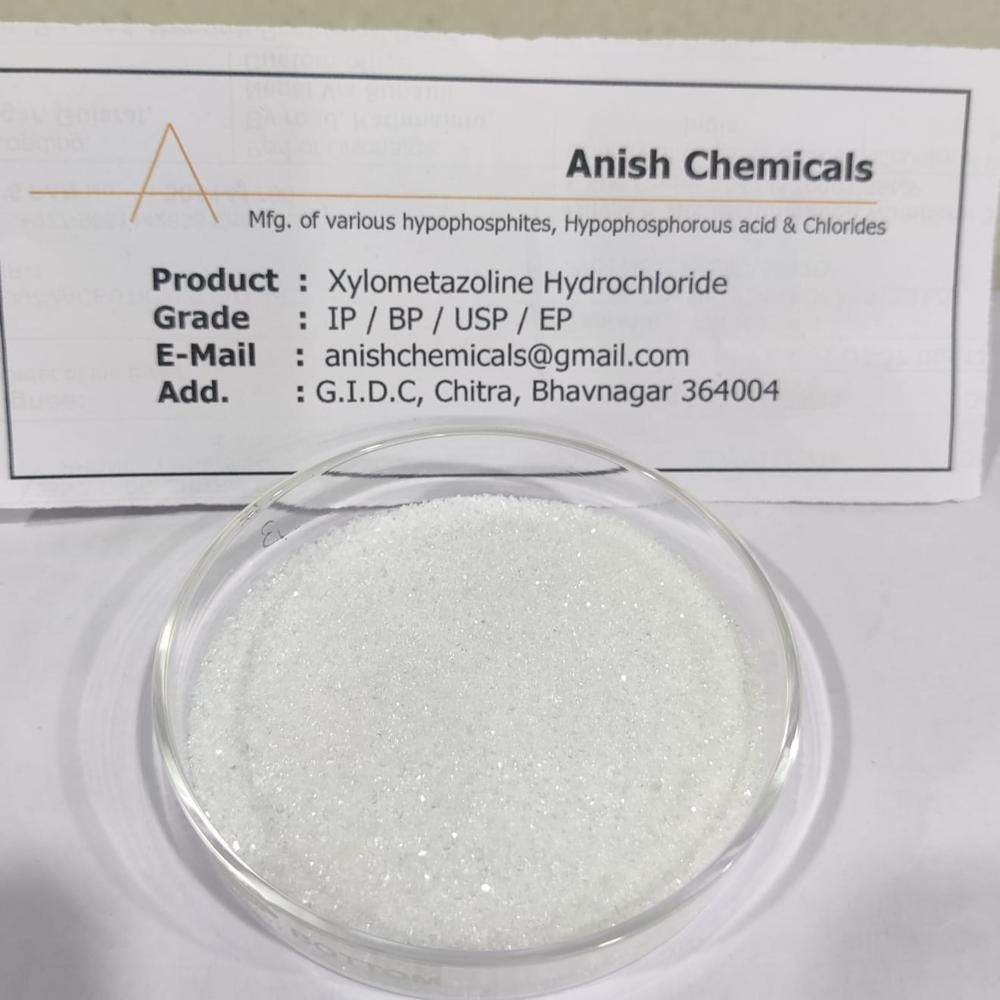
Xylometazoline Hydrochloride Pharma Grade
Product Details:
- Shape Crystal
- HS Code 293329
- Appearance white
- EINECS No 214-936-4
- Taste Bitter
- Ph Level 5.0 to 6.6
- Purity typically 98.0%
- Click to view more
X
Xylometazoline Hydrochloride Pharma Grade Price And Quantity
- 100 Kilograms
Xylometazoline Hydrochloride Pharma Grade Product Specifications
- typically 98.0%
- 280.84 g/mol Grams (g)
- Powder
- 214-936-4
- Bitter
- 5.0 to 6.6
- white
- Crystal
- 293329
- soluble in water, ethanol, and methanol
- 1218-35-5
- IP, BP, EP, USP
Xylometazoline Hydrochloride Pharma Grade Trade Information
- Cash Advance (CA)
- 10 Days
- 0.5 / 1 kg Inner : Laminated PET Aluminium Pouches Outer : Unlabeled Corrugated box / Drum
- All India
- Production certified according to Local GMP, FSSC22000, ISO 9001:2015, Halal & Kosher
Product Description
Xylometazoline hydrochloride uses
Applications/uses
Nasal congestion relief associated with the common cold, flu, and upper respiratory tract infections.
Treatment of symptoms related to allergic rhinitis (hay fever) and other respiratory allergies.
Reduction of sinus pressure and congestion caused by sinusitis (inflammation of the sinuses).
Adjuvant treatment of mucosal swelling due to otitis media (ear infections).
Xylometazoline hydrochloride is not used in the food industry. It is a potent pharmaceutical agent with specific physiological effects and is not a food additive, preservative, or flavoring agent. Products containing it often specify "no known food interactions" in their safety information.
Dietary Information : The product is suitable for the following nutrition:
Kosher, Halal, Vegetarian, Vegan
Allergen Free, GMO Free, Irradiation Free,
Specifications
|
Grade |
IP |
BP |
EP |
USP |
|
Description |
A white or almost white crystalline powder. |
White to off-white, odourless crystalline powder |
White to off-white, odourless crystalline powder |
A White to off white, odourless crystalline powder. |
|
Solubility |
Freely soluble in ethanol (95%), soluble in water and in chloroform, practically insoluble in ether |
Soluble in water, freely soluble in alcohol, Sparingly soluble in chloroform, practically insoluble in benzene and in ether |
Soluble in water, freely soluble in alcohol, Sparingly soluble in chloroform, practically insoluble in benzene and in ether |
Soluble in water, Freely soluble in alcohol, Sparingly soluble in chloroform and Practically insoluble in benzene and ether. |
|
Melting Point |
- |
- |
- |
Should be melts at 3000C with decomposition. |
|
Identification |
|
|||
|
a) By IR Spectrophotometry
|
IR spectrum of test sample is concordant with IR spectrum of Xylometazoline WS.
|
IR Spectrum of test sample is concordant with IR Spectrum of Xylometazoline Hydrochloride WS. |
IR Spectrum of test sample is concordant with IR Spectrum of Xylometazoline Hydrochloride WS. |
IR spectrum of sample recorded as Nujol oil should exhibit maxima and minima at the same wavelengths as that of the similar preparation of IR spectra of Xylometazoline Hydrochloride working standard. |
|
B: By UV
|
An absorbance A 0.05% soln in 0.1 M HCl shows an absorption maximum at about 265 nm & a minimum at about 257 nm with two inflections at about 270 nm & 275 nm, absorbance at about 265 nm, about 0.5
|
d) by UV The solution shows no fluorescence or at most the same fluorescence as a blank solution prepared in the same manner. The identification is not valid unless a solution prepared in the same manner using naphazoline hydrochloride CRS instead of the substance to be examined shows a distinct bluish fluorescence when examined under UV light at 365 nm. |
d) by UV The solution shows no fluorescence or at most the same fluorescence as a blank solution prepared in the same manner. The identification is not valid unless a solution prepared in the same manner using naphazoline hydrochloride CRS instead of the substance to be examined shows a distinct bluish fluorescence when examined under UV light at 365 nm. |
- |
|
c) By chemical test |
A violet colour develops.
|
|
|
-- |
|
d) Test for Chloride |
Gives reaction of chlorides |
It gives reactions of Chloride salts |
It gives reactions of Chloride salts |
- |
|
e) By TLC |
- |
The principle spot obtained in test solution is similar in position, colour and size to the principle spot in the chromatogram obtained with Xylometazoline Hydrochloride WS. |
The principle spot obtained in test solution is similar in position, colour and size to the principle spot in the chromatogram obtained with Xylometazoline Hydrochloride WS. |
The Rf value of the principle spot in the chromatogram of the identification preparation should be corresponds to that of standard preparation A as obtained in the test for chromatographic purity |
|
pH (5.0 % w/v solution in water) |
5.0 to 6.6 |
|
|
Between 5.0 to 6.6 |
|
Acidity/Alkalinity |
- |
Not more than 0.2 ml 0.01 M NaOH is required to change the colour of the indicator to yellow |
Not more than 0.2 ml 0.01 M NaOH is required to change the colour of the indicator to yellow |
- |
|
Appearance of solution |
- |
The solution is clear & not more intensely coloured then reference solution Y6 |
The solution is clear & not more intensely coloured then reference solution Y6 |
- |
|
Related substances by HPLC Impurity A Unspecified impurity Total impurities |
Not more than 0.2 % Not more than 0.1 % Not more than 0.5 % |
Not more than 0.2 % Not more than 0.1 % Not more than 0.5 % |
Not more than 0.2 Not more than 0.1 Not more than 0.5 |
|
|
Iron (ppm) |
Max. 50 ppm |
- |
- |
- |
|
Sulphates (ppm) |
Max. 200 ppm |
- |
- |
- |
|
Sulphated ash |
Not more than 0.1% |
Not more than 0.1 % |
Not more than 0.1 % |
|
|
Loss on drying |
Not more than 0.5% |
Not more than 0.5 % |
Not more than 0.5 % |
Not more than 0.5 |
|
Residual on ignition |
- |
- |
- |
Not more than 0.1 |
|
Chromatographic purity by TLC. |
- |
- |
- |
The sum of the intensities of all secondary spots obtained from the test solution corresponds to not more than 1.0 %. |
|
Assay by Potentiometer |
Between 99.0 and 101.0% calculated on dried basis |
by Potentiometer) Between 99.0 % and 101.0 % |
by Potentiometer) Between 99.0 % and 101.0 % |
Not less than 98.0 and Not more than 102.0 |
|
Residual Solvents (by GC, g/g) Methanol Acetone Isopropyl alcohol Tert butyl alcohol Ethyl acetate Benzene Methyl iso butyl ketone Toluene m-Xylene |
- |
Not more than 3000 Not more than 3000 Not more than 3000 Not more than 3000 Not more than 3000 Not more than 2 Not more than 500 Not more than 890 Not more than 500 |
Not more than 3000 Not more than 3000 Not more than 3000 Not more than 3000 Not more than 3000 Not more than 2 Not more than 500 Not more than 890 Not more than 500 |
- |
Tell us about your requirement

Price:
Quantity
Select Unit
- 50
- 100
- 200
- 250
- 500
- 1000+
Additional detail
Mobile number
Email

Other Products in 'Nasal Decongestant' category

Contact Details

- Plot No. 355/2, G.I.D.C. Estate, Chitra, Bhavnagar - 364004, Gujarat, India
- Phone : 91-942-9005558
GST : 24AADFA5012D1ZB

- Mr. Krut Dhroov (Partner)
- Mobile : +919429005558
- Send Inquiry
- E-Mail : anishchemicals@gmail.com
 Send Inquiry
ANISH CHEMICALS
All Rights Reserved.(Terms of Use)
Developed and Managed by Infocom Network Private Limited.
Developed and Managed by Infocom Network Private Limited.

