Welcome to Anish Chemicals



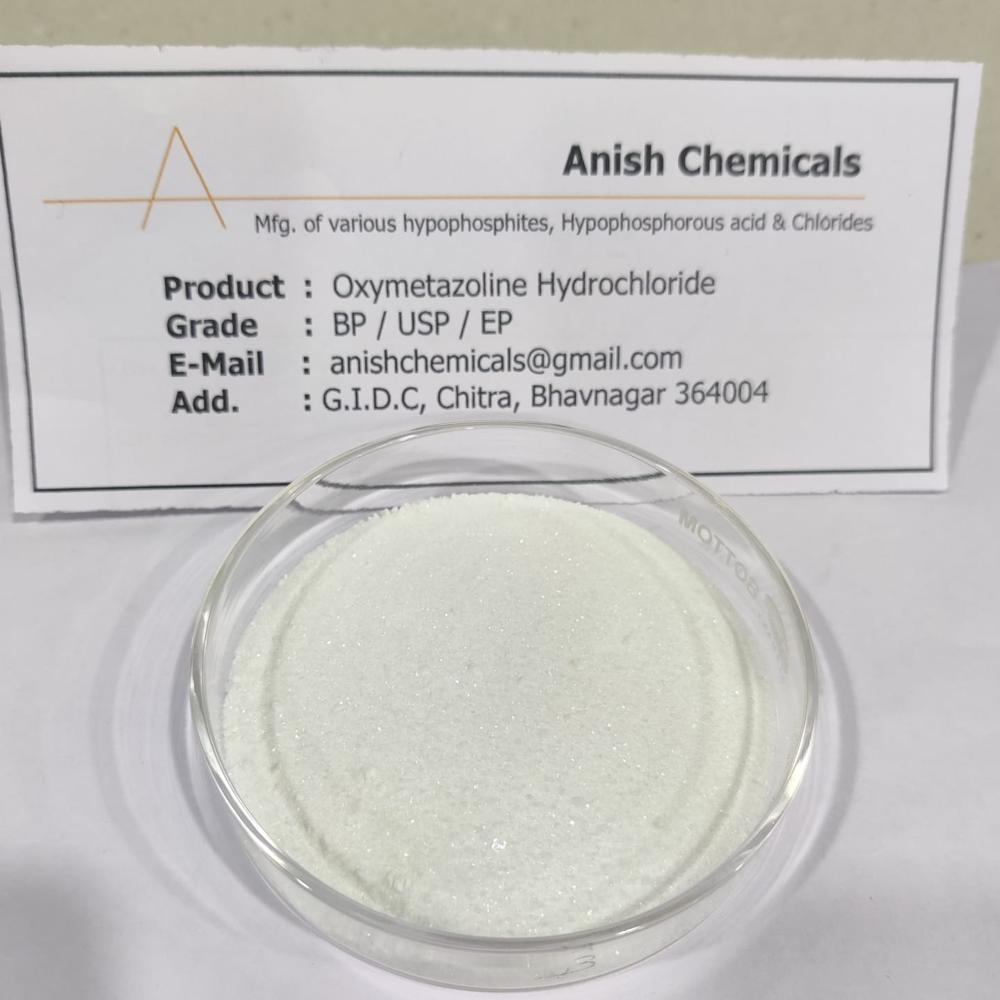
Oxymetazoline Hydrochloride Pharma Grade
Product Details:
- Taste Bitter
- EINECS No 219-015-0
- HS Code 2933.29
- Purity typically 98%
- Shape Crystal
- Molecular Formula C16H25ClN2O
- Appearance White
- Click to view more
X
Oxymetazoline Hydrochloride Pharma Grade Price And Quantity
- 100 Kilograms
Oxymetazoline Hydrochloride Pharma Grade Product Specifications
- Crystal
- C16H25ClN2O
- typically 98%
- 2933.29
- 219-015-0
- Bitter
- 296.84 g/mol Grams (g)
- Powder
- 4.0 and 6.5
- 2315-02-8
- White
- freely soluble in water and ethanol
Oxymetazoline Hydrochloride Pharma Grade Trade Information
- Cash Advance (CA)
- 10 Days
- 0.5 / 1 kg Inner : Laminated PET Aluminium Pouches Outer : Unlabeled Corrugated box / Drum
- All India
- Production certified according to Local GMP, FSSC22000, ISO 9001:2015, Halal & Kosher
Product Description
Oxymetazoline hydrochloride is a decongestant that constricts blood vessels to reduce swelling.
Applications/uses
Nasal Decongestant: Its primary use is in nasal sprays and solutions to provide temporary relief from nasal and sinus congestion caused by the common cold, hay fever, sinusitis, and allergies. It works by narrowing the blood vessels in the nasal passages, which reduces swelling and mucus production.
Ophthalmic Uses: It is used in eye drops to relieve eye redness and irritation caused by minor irritations like dust, wind, or swimming.
Treatment of Rosacea: A topical 1% cream formulation has been approved by the FDA for the treatment of persistent facial redness (erythema) associated with rosacea in adults.
Treatment of Ptosis (Drooping Eyelid): An ophthalmic solution of oxymetazoline (brand name Upneeq) was approved by the FDA in 2020 for treating acquired blepharoptosis in adults.
Hemostatic Agent: Due to its ability to constrict blood vessels, it can be used topically to help manage nosebleeds (epistaxis).
Dental Procedures: A combination intranasal spray containing oxymetazoline and tetracaine can be used in dentistry for regional anesthesia during certain procedures.
Pharmaceutical Standards: High-purity grades (USP, BP, EP) are produced for use as reference standards in quality control and analytical testing of pharmaceutical formulations.
Dietary Information : The product is suitable for the following nutrition:
Kosher, Halal, Vegetarian, Vegan
Allergen Free, GMO Free, Irradiation Free,
Specifications
|
Grade |
BP |
EP |
USP |
|
|
Description
|
White or almost white, crystalline powder. |
white or almost white, crystalline powder |
A white to practically off white, fine crystalline powder. Is hygroscopic. |
|
|
Solubility |
Freely soluble in water and in ethanol |
freely soluble in water and in ethanol (96 per cent) |
Soluble in water, in alcohol, practically insoluble in benzene, in chloroform and in ether. |
|
|
Melting Point |
|
|
Should melts at about 300C with decomposition. |
|
|
Identification |
||||
|
a) By IR |
|
|
IR spectrum of sample recorded as Nujol mull should exhibit transmission minima (absorption maxima) at the same wavelengths to those in the spectrum obtained with the Oxymetazoline hydrochloride-working standard. |
|
|
b) By Assay (HPLC) |
|
|
The retention time of the major peak of the sample solution should correspond to that of the standard solution, as obtained in the assay. |
|
|
c) By Chloride test |
|
|
A curdy white precipitate should form, which settles in the test tube, indicating the presence of chlorides ions. |
|
|
Appearance of Solution |
The solution is clear and not more intensely colored than reference solution BY7 |
The solution is clear and not more intensely colored than reference solution BY7 |
|
|
|
pH (5 % w/v solution in water) |
|
|
Between 4.0 and 6.5 |
|
|
Acidity /Alkalinity |
Not more than 0.4 mL of0.01 M sodium hydroxide |
Not more than 0.4 mL of 0.01 M sodium hydroxide |
|
|
|
Water |
maximum 0.3 % |
|
|
|
|
Loss on drying (% w/w, determined on 1 g at 1050C, for 3 hrs) |
|
maximum 1.0 per cent, |
Not more than 1.0 |
|
|
Sulphated Ash |
Maximum0.1 percent |
maximum 0.1 per cent |
|
|
|
Residue on Ignition (%w/w, determined on 1 g) |
|
|
Not more than 0.1 |
|
|
Assay (% w/w, by HPLC as C16H24N2O.HCl on dried basis) |
99.0 per cent to 101.0 per cent |
99.0 per cent to 101.0 per cent |
Not less than 98.5 and Not more than 101.5 |
|
|
Residual Solvent (by GC, g/g) |
||||
|
Methanol Acetone Isopropyl alcohol Ethyl acetate Dimethyl sulfoxide Toluene Additional Solvent Benzene |
|
|
Not more than 1000 Not more than 1000 Not more than 1000 Not more than 1000 Not more than 1000 Not more than 500
Not more than 2 |
|
|
Organic impurities (w/w) Related compound A Any individual impurity Total impurities |
|
|
0.15 0.10 0.50 |
|
Tell us about your requirement

Price:
Quantity
Select Unit
- 50
- 100
- 200
- 250
- 500
- 1000+
Additional detail
Mobile number
Email

Other Products in 'Nasal Decongestant' category

Contact Details

- Plot No. 355/2, G.I.D.C. Estate, Chitra, Bhavnagar - 364004, Gujarat, India
- Phone : 91-942-9005558
GST : 24AADFA5012D1ZB

- Mr. Krut Dhroov (Partner)
- Mobile : +919429005558
- Send Inquiry
- E-Mail : anishchemicals@gmail.com
 Send Inquiry
ANISH CHEMICALS
All Rights Reserved.(Terms of Use)
Developed and Managed by Infocom Network Private Limited.
Developed and Managed by Infocom Network Private Limited.

