Welcome to Anish Chemicals



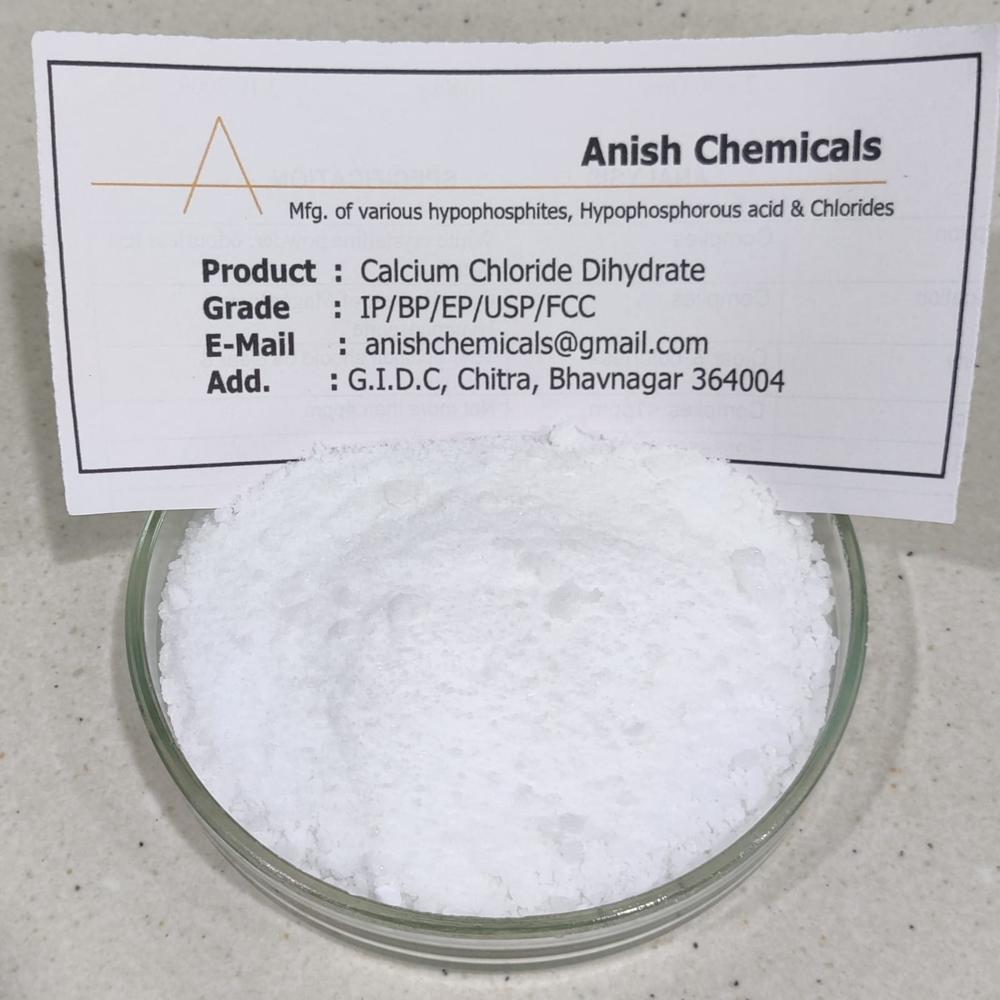


Calcium Chloride Dihydrate
Product Details:
- Molecular Formula CaCl2 - 2H2O
- Physical Form Powder
- Taste Salty
- Shape Crystal
- HS Code 28272000
- Ph Level 4.5 to 11.0
- CAS No 10035-04-8
- Click to view more
X
Calcium Chloride Dihydrate Price And Quantity
- 100 Kilograms
Calcium Chloride Dihydrate Product Specifications
- CaCl2 - 2H2O
- 28272000
- Crystal
- Salty
- Powder
- 4.5 to 11.0
- 10035-04-8
- 99%
- freely soluble in water
- 147.01 g/mol Grams (g)
- 233-140-8
Calcium Chloride Dihydrate Trade Information
- Cash Advance (CA)
- No
- Free samples are available
- 25 KG HDPE Woven bags with inner liner LDPE Liner 50 KG HDPE Woven bags with inner liner LDPE Liner 25 KG HDPE Drum with inner liner LDPE Liner 50 KG HDPE Drum with inner liner LDPE Liner 25 KG Kraft Paper Drum with inner LDPE Liner 50 KG Kraft Paper Drum with inner LDPE Liner 25 KG 3 Ply Paper bag with inner LDPE Liner 25 KG Kraft Paper laminated HDPE Bag with Liner LDPE Liner
- All India
- Production certified according to Local GMP, FSSC22000, ISO 9001:2015, Halal & Kosher
Product Description
Applications / Uses
Firming agent: Added to canned fruits and vegetables to maintain a crisp texture and prevent them from becoming soft during processing and storage.
Cheese production: Helps in the curd formation process when added to milk, leading to a more consistent and higher-quality cheese.
Pickling: Used in pickling brine to help maintain the firmness of pickles and can be used as a substitute for some sodium chloride.
Preservative: Can act as a preservative to extend the shelf life of various food products.
Molecular gastronomy: Essential for techniques like spherification, which creates spheres with a liquid center.
Electrolyte replacement: Used to treat conditions like hypocalcemia (low blood calcium) and to manage the effects of hyperkalemia (high potassium levels).
Cardiac support: Included in cardioplegic solutions used during heart surgery to stop the heart.
Antidote: Utilized to counteract the effects of certain drug overdoses, such as calcium channel blocker or beta-blocker overdose.
Desiccant: Acts as a drying agent in packaging to protect pharmaceutical products from moisture, which can degrade their quality and stability.
Dietary Information: The product is suitable for the following nutrition: Kosher, Halal, Vegetarian, Vegan
Allergen Free, GMO Free, Irradiation Free
Specifications
| Grade | IP | BP | EP | USP | FCC |
| Description | A white, crystalline powder or fragments or granules; odourless; hygroscopic | White or almost white, crystalline powder, hygroscopic | White or almost white, crystalline powder, hygroscopic | White, hard, odourless fragments or granules. | White hard fragments, granules or powder, it is deliquescent |
| Identification | It gives reactions (A) and (B) of calcium and reaction A of chloride salts | It gives reactions (a) of chlorides, it gives reactions of Calcium | It gives reactions (a) of chlorides, it gives reactions of Calcium | It gives reactions of chlorides &Calcium. | Positive to the test of Calcium and Chloride |
| Solubility | Freely soluble in water and in ethanol (95%). | Freely soluble in water, soluble in 96% ethanol | Freely soluble in water, soluble in 96% ethanol | Freely soluble in water, in alcohol, very soluble in boiling water | It is soluble in water and slightly soluble in alcohol |
| Clarity and colour of solution (10%) | Solution A is clear and not more intensely coloured than reference solution | Solution S is clear and not more intensely colored than reference solution | Solution S is clear and not more intensely colored than reference solution Y6 | - | - |
| Acidity/Alkalinity | NMT 0.2 ml of 0.01M of NaOH or 0.01 M HCl | NMT 0.2 ml of 0.01M of NaOH or 0.01 M HCl | NMT 0.2 ml of 0.01M of NaOH or 0.01 M HCl | - | - |
| Sulphate | NMT. 300 ppm | NMT. 300 ppm | NMT. 300 ppm | - | - |
| Iron | NMT. 20 ppm | NMT. 10 ppm | NMT. 10 ppm | No Turbidity or precipitate is produced | - |
| Barium | No opalescence Present | No opalescence Present | No opalescence Present | - | - |
| Magnesium & Alkali Metals | NMT 1.0 % | NMT. 0.5 % | NMT. 0.5 % | NMT. 5 mg / 1.0% | NMT 4.0% |
| Heavy Metals | NMT. 10 ppm | - | NMT. 20 ppm | - | - |
| Arsenic | NMT. 3 ppm | - | - | - | NMT. 3 mg/kg |
| Lead | - | - | - | - | NMT. 5 mg/kg |
| Aluminium & Phosphate | No Turbidity or precipitation | NMT 1 PPM | NMT 1 PPM | No Turbidity or precipitate is produced | - |
| Fluoride | - | - | - | - | NMT. 0.004% |
| Assay | 97%-103% | 97%-103% | 97%-103% | 99%-107% | NLT 99.0% & NMT 107% |
Tell us about your requirement

Price:
Quantity
Select Unit
- 50
- 100
- 200
- 250
- 500
- 1000+
Additional detail
Mobile number
Email

Other Products in 'Chloride' category


Contact Details

- Plot No. 355/2, G.I.D.C. Estate, Chitra, Bhavnagar - 364004, Gujarat, India
- Phone : 91-942-9005558
GST : 24AADFA5012D1ZB

- Mr. Krut Dhroov (Partner)
- Mobile : +919429005558
- Send Inquiry
- E-Mail : anishchemicals@gmail.com
 Send Inquiry
ANISH CHEMICALS
All Rights Reserved.(Terms of Use)
Developed and Managed by Infocom Network Private Limited.
Developed and Managed by Infocom Network Private Limited.

